
How to Stop Overthinking at Night
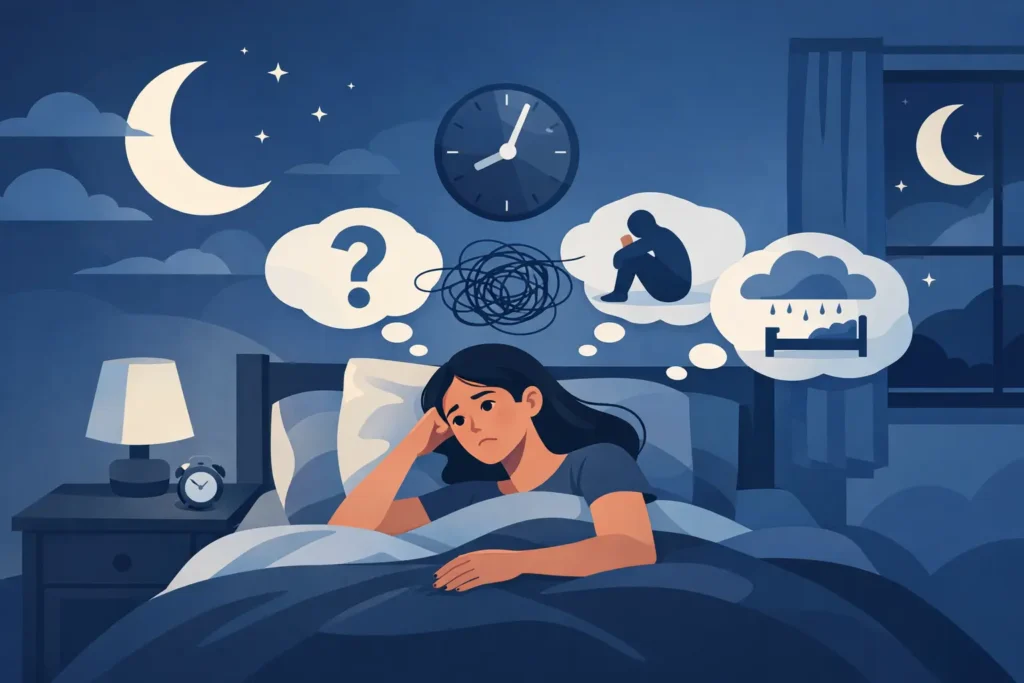
You turn the light off, finally get still, and your mind decides this is the perfect moment to replay awkward conversations, predict tomorrow’s problems, and question decisions you made three years ago. If you are wondering how to stop overthinking at night, the first thing to know is this: you are not weak, dramatic or broken. A busy mind at bedtime is usually a tired nervous system trying, in the wrong way, to keep you safe.
For many people, night-time overthinking is not really about the night. It is what happens when the day stops distracting you. The emails have ended, the children are asleep, the house is quieter, and all the thoughts you pushed aside suddenly have space to shout. That is why trying to force yourself to “just stop thinking” rarely works. The harder you fight your mind, the more alert it becomes.
What helps is a calmer, more strategic approach. You want to reduce the pressure in the system, rather than win an argument with your thoughts.
Why overthinking gets worse at night
During the day, your attention is pulled in lots of directions. At night, there is far less competition. Your brain notices the silence and starts scanning. If you are already under stress, dealing with anxiety, or carrying too much responsibility, that scanning can become mental overdrive.
There is also a simple physical factor. When you are overtired, your brain becomes less flexible. Small worries can feel bigger, and perspective is harder to access. You may know logically that a problem can wait until morning, but your body does not feel convinced. It feels vigilant.
For some people, overthinking centres on practical concerns such as money, work or family. For others, it is more emotional – regret, self-criticism, health anxiety, relationship worries, or a general sense of dread. The content varies, but the pattern is similar: the mind starts trying to solve, prevent or control everything at once.
How to stop overthinking at night without fighting your mind
The most effective approach is not to demand instant silence. It is to give your mind a different job. When you do that, the brain often settles more quickly because it no longer feels ignored or under attack.
Start by naming what is happening. A simple internal statement such as, “I am overthinking because I am tired and wound up,” can be surprisingly powerful. It creates a little distance between you and the thought spiral. You are observing it, not becoming it.
Next, bring your attention out of the story and back into the body. Slow breathing helps, but only if it feels natural. If counted breathing makes you more self-conscious, try this instead: breathe out a little longer than you breathe in. That longer exhale sends a message of safety to the nervous system. You are not trying to perform relaxation perfectly. You are allowing your body to downshift.
It can also help to use a gentle mental anchor. Choose something dull enough that it does not stimulate you, but steady enough to hold attention. That might be repeating a neutral phrase, picturing a familiar peaceful place, or slowly noticing the weight of your body on the mattress. The goal is not to banish thoughts completely. The goal is to stop feeding them.
The habits that quietly make night-time overthinking worse
What you do in the hour before bed matters more than many people realise. If your brain is moving straight from problem-solving, scrolling, news, alcohol, or late-night work into bed, it has had no real transition.
Phones are a common culprit, not only because of light exposure but because of mental stimulation. One last look can become twenty minutes of comparison, bad news or emotional activation. If your mind is already prone to overthinking, that is like adding fuel just before lights out.
Alcohol is another one that catches people out. It may make you feel drowsy initially, but it often disrupts sleep later in the night and can leave you waking more anxious or mentally busy. Caffeine late in the day can have a similar effect, even if you feel you “can sleep on it”. Sometimes people fall asleep, but the quality of sleep is poorer and the mind is more restless.
Then there is the habit of using bedtime as your first and only moment of reflection. If the entire day has been about coping, rushing and pushing on, your mind will try to process everything once you finally stop. That is not a personal failing. It is a backlog.
Create a short evening offload
If you want to know how to stop overthinking at night, one of the most practical changes is to empty your head before bed rather than in bed. This does not need to be a perfect journal routine with candles and a beautiful notebook. Plain paper will do.
Spend five to ten minutes writing down what is on your mind. Include worries, tasks, reminders, half-formed thoughts, anything unfinished. Then separate it into two categories: what needs action, and what does not need solving tonight. That distinction matters.
A thought such as “I must not forget to ring the school” belongs on tomorrow’s list. A thought such as “What if everything goes wrong?” does not have a useful answer at 11.30 pm. You can acknowledge it without entering a debate with it.
Some people also benefit from writing one containment sentence at the end, such as, “I have noted what matters. The rest can wait until tomorrow.” It sounds simple because it is. Simple is often what works when the mind is overstimulated.
When getting up is the better option
If you have been lying there for a long time getting more frustrated, staying in bed can make the problem worse. Bed starts to become associated with pressure, effort and failure. In that case, get up for a short while.
Keep the lights low. Do something quiet and unstimulating. Sit with a blanket, read a few pages of something calm, or listen to a gentle audio track. Avoid checking messages, doing chores, or turning the moment into a productivity session. The aim is to let your system settle enough that bed feels like a place to rest again.
This is not about giving up on sleep. It is about stepping out of the struggle.
When overthinking is really anxiety in disguise
Sometimes night-time overthinking is not just a bad habit. It is a sign that your nervous system is spending too much time on high alert. If your mind regularly races through worst-case scenarios, replays conversations, or catastrophises about health, relationships or work, there may be a deeper anxiety pattern underneath it.
That is where sheer willpower tends to fail. You may understand perfectly well that your thoughts are unhelpful and still feel unable to stop them. This is often the point at which people feel frustrated with themselves, when actually they need a different kind of support.
Hypnotherapy can be helpful here because it works with the part of the mind that keeps repeating the pattern automatically. Rather than coaching you to battle every thought one by one, it helps calm the underlying response that drives the overthinking in the first place. For people who are tired of analysing the problem and just want relief, that can feel like a very different experience.
At Jennie Francis Hypnotherapy, many clients seek help because they are exhausted by anxious thinking, poor sleep or a mind that will not switch off. The work is practical, focused and designed to create change that feels natural rather than forced.
How to stop overthinking at night if you are under real pressure
There is an important trade-off here. Some advice on sleep assumes your worries are exaggerated. But sometimes they are not. You may be dealing with a demanding job, family strain, grief, a health concern, or a major life decision. In those situations, the answer is not to pretend everything is fine.
What matters is timing. Night-time is rarely when your best thinking happens. Tired minds are harsher, more fearful and less balanced. If something genuinely needs attention, give it proper attention in daylight hours. Put a time in the diary to think about it, discuss it, or take action. This helps your brain learn that concerns are not being ignored, just handled at a better time.
That distinction often reduces the urgency. Your mind quietens when it trusts there is a plan.
A kinder standard for sleep
One final point is worth holding on to. Many people overthink not only about life, but about sleep itself. They start monitoring the clock, calculating lost hours, and panicking about how tomorrow will go. That extra layer of pressure can be as disruptive as the original worry.
Try replacing the demand to sleep with permission to rest. Rest still has value. A calm body in a dark room is not the same as failing. The less frightened you become of being awake, the easier it is for sleep to return.
If your mind has learnt to race at night, it can also learn something new. With the right support and a few consistent changes, bedtime can stop feeling like a battle and start feeling safe again.